





Nothing to configure — the repository address is passed at tool-call time, so a single installation handles any number of repositories.
A universal MCP server for the OAI-PMH protocol (Open Archives Initiative – Protocol for Metadata Harvesting).
It lets any MCP client (Claude, ChatGPT, Cursor…) query any public OAI-PMH
repository — digital libraries built on dLibra (e.g. the
Wielkopolska Digital Library), as well as DSpace,
EPrints, PubMed Central and others — with no per-host configuration. The
repository address (base_url) is supplied on every call.
A faithful wrapper around the six OAI-PMH verbs plus a convenient layer for bulk harvesting:
| Tool | Role |
|---|---|
identify |
repository identity (name, protocol version, granularity, deleted-record policy) |
list_metadata_formats |
available metadata formats (oai_dc, mods, marc…) |
list_sets |
collections / sets |
list_identifiers |
record headers only (cheap overview) |
list_records |
a page of full records + pagination token |
get_record |
a single record by identifier |
harvest_records |
auto-pagination: fetches multiple pages up to a limit, resumable |
Output in three formats (format): text (default, token-efficient),
json (machine-readable), xml (raw original).
uvx oai-pmh-mcp        # run without installing (stdio)
# or
uv tool install oai-pmh-mcpclaude mcp add oai-pmh -- uvx oai-pmh-mcp{
"mcpServers": {
"oai-pmh": { "command": "uvx", "args": ["oai-pmh-mcp"] }
}
}Defaults to stdio. Remote mode uses streamable-HTTP:
oai-pmh-mcp --transport http --host 0.0.0.0 --port 8000"Check what collections
https://www.wbc.poznan.pl/dlibra/oai-pmh-repository.xmlhas and show the 5 most recent records."
The model will call identify → list_sets → list_records and assemble the answer.
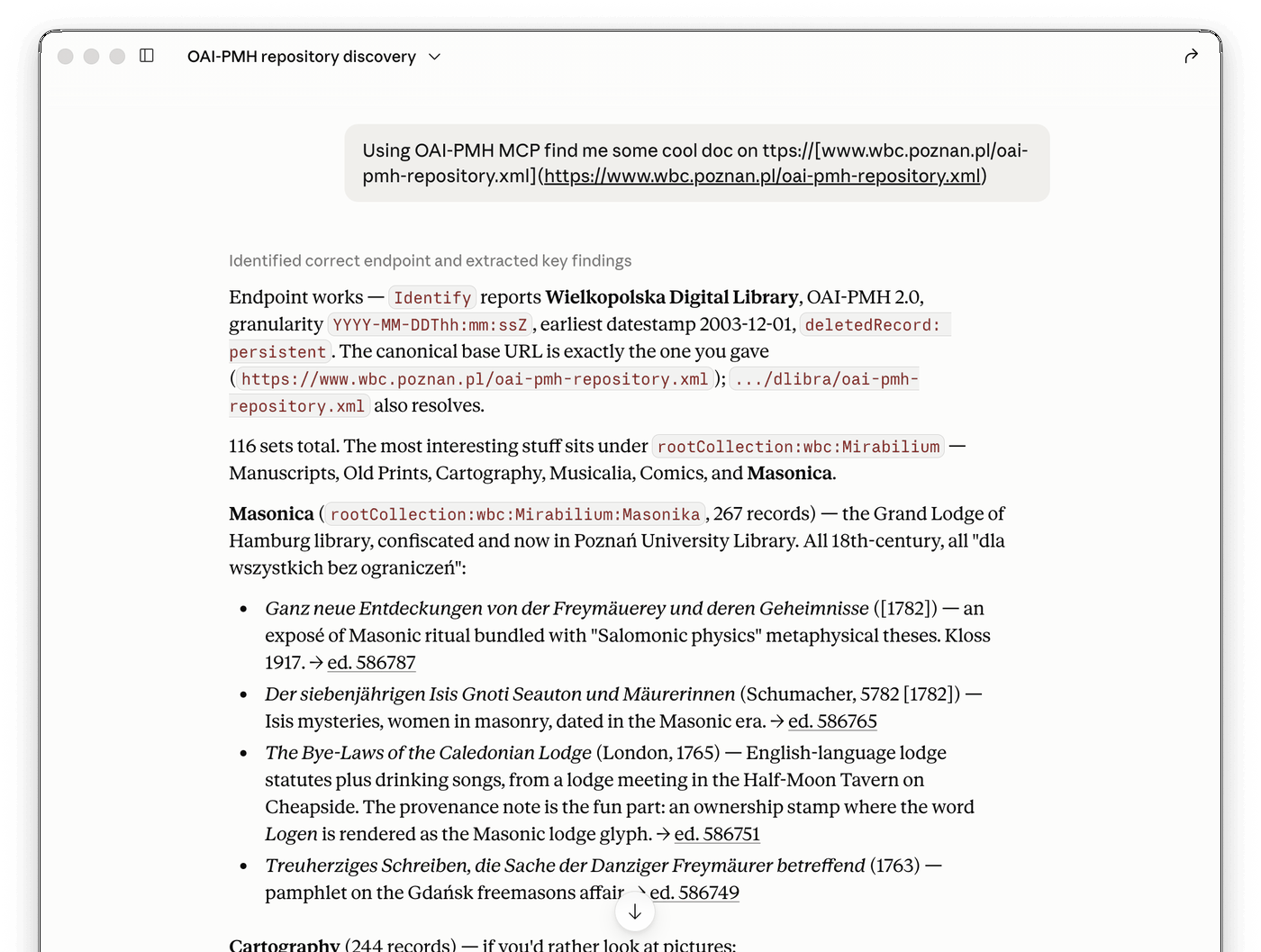
One prompt, pointed at the Wielkopolska Digital Library.
identify confirms the endpoint — OAI-PMH 2.0, records back to 2003-12-01,
deletedRecord: persistent. list_sets returns all 116 sets and finds the
interesting ones under rootCollection:wbc:Mirabilium. list_records then reads
out Masonica (267 records): the Grand Lodge of Hamburg library, confiscated
during the war and now held in Poznań — including a 1782 exposé of Masonic
ritual and the by-laws of a London lodge that met in the Half-Moon Tavern on
Cheapside.
Nothing about that repository is hardcoded — the same tools answer the same way for any OAI-PMH endpoint you name.
uv sync
uv run pytest            # unit tests (offline, fixtures)
uv run pytest -m integration   # network tests (optional)
uv run ruff check .OAI-PMH is a metadata protocol — the server does not fetch object content (scans, PDFs). It is read-only, without authentication, without caching.
- XML parsing is hardened — the parser does not expand entities or reach out to the network/DTD (protection against XXE and "billion laughs" from untrusted repositories).
harvest_recordshas hard limits (max records, max pages, abort on lack of progress) — a malicious server cannot trap the client in a loop.- SSRF by design: the server fetches any
base_urlsupplied by the client (that is the point). Only thehttp/httpsschemes are allowed. If you deploy the remote (HTTP) variant on a network with internal resources, run it in an environment with restricted outbound networking — the model could point at an internal address (e.g. a cloud metadata endpoint).